 By Md Arif Ahamed
Quick summary: Non-refundable rate meaning in hotels: lower price, prepayment, no refund. See the pricing formula, a worked example, best uses and mistakes to avoid.
A non-refundable rate is a discounted hotel price that guests pay in advance, or commit to paying in full, with no refund if they cancel or change dates. In return for accepting that risk, the guest gets a lower price than the flexible rate. For hotels, it secures revenue early, reduces cancellations and helps manage demand, but it must be priced carefully so it does not give away too much margin.
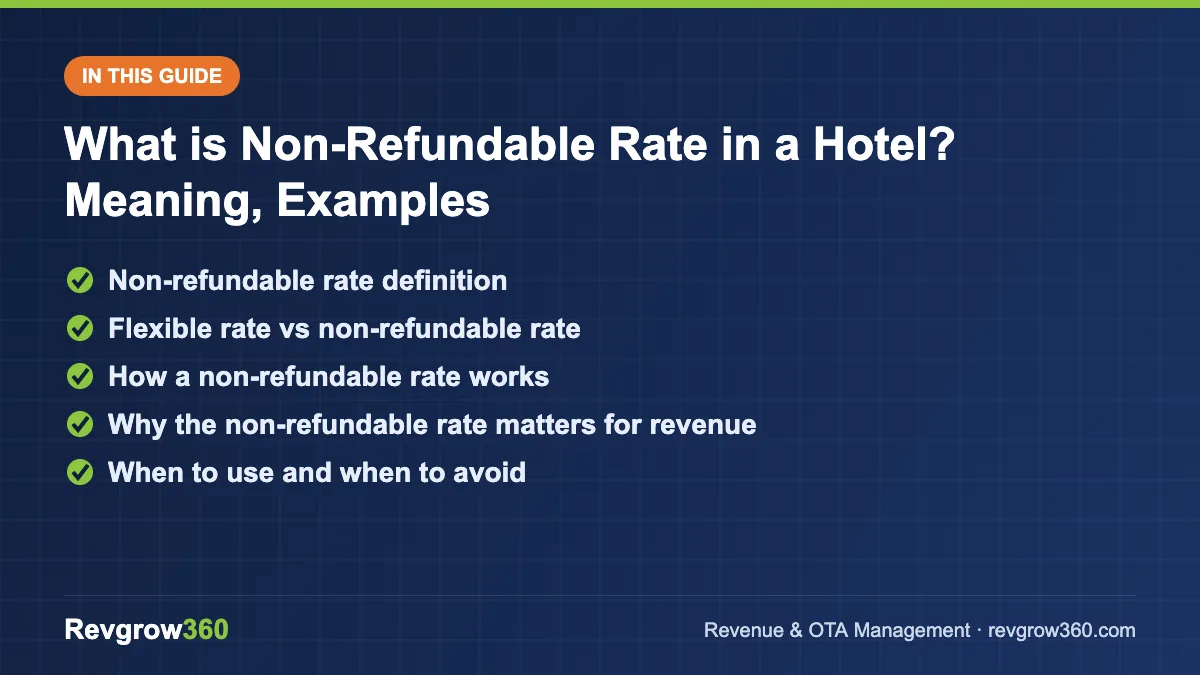
- Lower price, no free cancellation
- Discount below cancellation loss
- Secure revenue and cash early
This entry explains what a non-refundable rate is, how to price it, a worked example, when to use it and common mistakes.
Non-refundable rate definition
A non-refundable rate is a rate plan with strict cancellation terms. Once the booking is made, the guest cannot cancel or modify without losing the full amount, or a large part of it. Some are prepaid at the time of booking; others are charged to a card but the guest pays nothing at the hotel.
It sits next to a flexible rate that allows free cancellation until a set time, for example 24 or 48 hours before arrival. The gap between the two prices is the guest’s reward for accepting the risk.
Polite cancellation and refund letters.
Flexible rate vs non-refundable rate
| Feature | Flexible rate | Non-refundable rate |
|---|---|---|
| Price | Higher | Lower, often 5 to 15 percent below flexible, depending on market |
| Cancellation | Free until a cut-off | Not allowed, or no refund |
| Payment | Usually at the hotel | Prepaid or card charged at booking |
| Hotel risk | Cancellation and no-show | Low |
| Best for | Uncertain plans, corporate | Certain plans, price-sensitive leisure |
The percentage above is a typical range, not a rule. Test what works in your market.
Revenue Health Score · free
Free tool: check your hotel’s revenue health
Answer a few quick questions about your rooms, rates, OTAs and reviews. Get a score out of 100, your weakest revenue areas and the first actions to fix them.
How a non-refundable rate works
- The hotel creates a separate rate plan with a lower price and strict terms.
- The guest books and pays, or the card is charged at booking, depending on channel rules.
- If the guest cancels, the hotel keeps the payment. If the guest arrives, the stay proceeds normally.
- If the guest does not arrive, the hotel keeps the money and can resell the room only if it knows of the no-show in time.
On OTAs, non-refundable terms and payment timing are set within each platform’s rules. Check the current options in your extranet, and see our guide on OTA management.
Pricing formula and worked example
A fair discount compensates the guest for the lost flexibility but still earns you more expected revenue than the flexible rate. Use:
Break-even discount = Flexible rate x cancellation rate of the flexible bookings
If 12 percent of flexible bookings usually cancel and the room cannot be resold, a non-refundable discount of up to about 12 percent still keeps expected revenue equal. A smaller discount makes you better off. Take a 40-room hotel in Kolkata with a flexible rate of ₹5,000.
| Item | Flexible rate | Non-refundable rate |
|---|---|---|
| Listed price | ₹5,000 | ₹4,500 (10 percent lower) |
| Assumed cancellation of bookings | 12 percent | 0 percent |
| Expected revenue per booking (if cancelled rooms stay empty) | ₹5,000 x 88 percent = ₹4,400 | ₹4,500 |
In this example the non-refundable rate earns slightly more expected revenue, and guarantees cash earlier. If a cancelled room is often resold, the flexible rate’s real cancellation loss is lower, so the discount should be smaller. All numbers are hypothetical.
Why the non-refundable rate matters for revenue
- Protects revenue: fewer last-minute cancellations means stable forecasts. See hotel demand forecasting.
- Improves cash flow: prepayments arrive before the stay.
- Attracts price-sensitive guests: a lower headline price improves ranking and conversion on some OTAs.
- Supports overbooking decisions: if fewer guests cancel, you need less buffer. Read hotel overbooking strategy.
- Segments guests: certain guests pay more for flexibility, others less for certainty.
When to use and when to avoid
Good times to use
- High-demand dates when you expect to sell out anyway but want secure bookings.
- Long advance windows when cancellation risk is highest.
- Low-demand periods when you need to create early bookings.
Times to be careful
- When the discount is larger than the cancellation risk you are avoiding.
- When guests complain heavily about strict policies, which can affect reviews.
- For corporate or group business, where flexibility is usually expected.
- During uncertain travel conditions, such as floods, strikes or health advisories. Consider offering date changes as goodwill.
Common mistakes
- Offering too big a discount, which pushes all guests to the cheaper rate.
- Unclear terms. State “non-refundable” in the booking engine, the confirmation and the description.
- Not allowing any exception for genuine emergencies. Decide your own policy in advance; a rigid response can create bad reviews.
- Mismatch between OTA and direct policy, which may affect rate parity.
- Failing to reconcile prepayments and commissions in accounts.
How to present a non-refundable rate to guests
Clear communication reduces complaints. Use plain words next to the price: “Pay now, save more. No cancellation or changes.” Repeat the policy in the confirmation email and the pre-arrival message. Staff who answer calls should be ready to explain the difference calmly:
“This rate is ₹500 lower per night because it is prepaid and cannot be changed. If your plans may change, our flexible rate lets you cancel free until 48 hours before arrival. Which would you prefer?”
Offering both choices lets the guest decide, which is better than forcing one policy on everybody.
Handling genuine emergencies
Create a short internal guideline. For example, a medical emergency with a document may earn a date change or credit voucher, while a change of mind does not. Give front office managers authority to decide within limits. Consistency matters more than the exact rule.
Accounting note
Prepayments are received before the stay but are earned only on the stay date. Ask your accountant how to record advances and no-show retention, and how GST applies, as rules can change. Always confirm with a CA or the current official source.
Related terms
Flexible rate, BAR, rate plan, prepayment, cancellation policy, no-show, deposit and advance purchase rate.
Key takeaways
- A non-refundable rate trades flexibility for a lower price and early payment.
- Set the discount below your typical cancellation loss so expected revenue improves.
- Use it for secure demand, not as a blanket discount.
- Be clear about terms and decide how to handle genuine emergencies.
To set the right mix of flexible and non-refundable rates, explore Revgrow360’s hotel revenue management service or book a free consultation.
For more background, see this hotel industry overview on Wikipedia.
Frequently asked questions
What does non-refundable rate mean in a hotel?
It is a discounted rate where the guest pays in advance or commits to full payment and cannot cancel or change the booking without losing the money. The hotel gains secure revenue, and the guest gets a lower price than the flexible option.
How much cheaper should a non-refundable rate be?
Many hotels price it roughly 5 to 15 percent below the flexible rate, but the right gap depends on your market. Keep the discount smaller than the revenue you typically lose from cancellations of flexible bookings that cannot be resold.
Can a hotel refund a non-refundable booking?
The hotel can choose to offer an exception, such as a date change or credit, for genuine emergencies. Decide the policy in advance and apply it consistently. Remember that OTA terms and channel rules may also affect refund handling.
Does a non-refundable rate hurt reviews?
It can when terms are unclear or enforced rigidly during emergencies. Show the policy clearly at booking, in the confirmation and at check-in, and consider flexible goodwill options so guests do not feel trapped.
More Hotel Glossary guides

What is Stop Sell in a Hotel? Meaning and Examples
Stop sell closes a date, room type, rate or channel to new bookings. Learn when to use it, how it differs from…

What is Hotel Allotment? Meaning, Formula and Examples
A hotel allotment holds rooms for a travel partner until a release date. Learn how it works, how to measure pick-up and…
What is Package Rate in a Hotel? Meaning and Examples
A package rate bundles a room with meals or experiences at one price. Here is the meaning, formula, example and common mistakes.
Commissionable Rate in Hotel: Meaning and Examples
A commissionable rate includes a commission paid to the agent or OTA who sells the room. See the formula, an example and…

Net Rate in Hotel: Meaning, Formula and Examples
A net rate is a confidential price given to travel partners with no commission. See how it works, a worked example and…
Corporate Rate in Hotel: Meaning, Example and Tips
A corporate rate is a negotiated hotel room rate for company travellers. See how it works, a worked example and how to…
Free PDF checklist
Where is your hotel losing money?
27 quick checks on pricing, OTAs, reviews and direct bookings, with the first fix for every leak.
Get the free checklist →