 By Md Arif Ahamed
Quick summary: Learn what ARI (average rate index) in hotel benchmarking means, the formula, a worked rupee example and how to read it with MPI and RGI.
ARI (average rate index) in hotel management compares your average daily rate with the average daily rate of your competitive set. It is calculated by dividing your ADR by the comp set’s ADR and multiplying by 100. An ARI of 100 means your rate matches your market, above 100 means you earn a premium over competitors, and below 100 means you sell at a discount.
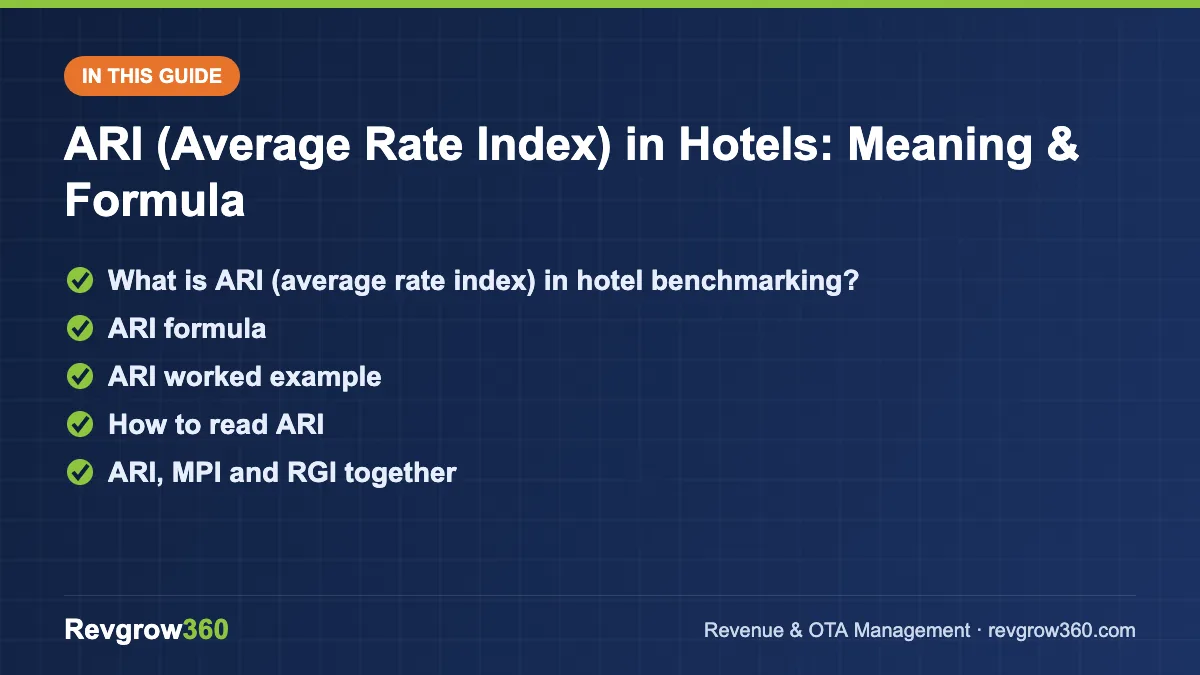
- Your ADR vs comp set ADR
- ARI = ADR ratio x 100
- Premium above 100
ARI is the rate index among the three benchmark indexes, alongside MPI and RGI. It tells you whether your price position is right, which is critical because rate is the biggest lever in revenue management.
What is ARI (average rate index) in hotel benchmarking?
Your ADR tells you what you earn per room sold. It does not tell you whether that is good for your market. A hotel with an ADR of ₹4,000 might be a premium player in one city and a discount player in another. ARI places your ADR next to your competitors’ and gives you a single, easy-to-read number.
The competitive set is a group of hotels similar to yours in location, category and guest type. Benchmark providers such as STR supply set averages to subscribers, and smaller hotels may build a simple version by checking OTA rates for several similar hotels over the same dates.
Compare your performance with your competitors.
ARI formula
ARI = (Hotel ADR / Comp set ADR) x 100
ADR is rooms revenue divided by rooms sold. See average daily rate for a full explanation.
ARI worked example
A hypothetical 40-room hotel in Jaipur earned ₹14,40,000 in rooms revenue by selling 360 room-nights in a month.
| Step | Calculation | Result |
|---|---|---|
| Hotel ADR | 14,40,000 / 360 | ₹4,000 |
| Comp set ADR | From benchmark report | ₹4,250 |
| ARI | (4,000 / 4,250) x 100 | 94.1 |
The hotel sells at about 6 percent below the average of its set. Is this good or bad? It depends on the other indexes. If MPI is high, the lower rate may be buying extra occupancy. If MPI is also low, the hotel is both cheaper and emptier, which suggests problems with demand or product, not just price.
How to read ARI
| ARI value | Meaning | What to check |
|---|---|---|
| Above 100 | You achieve a rate premium | Does occupancy hold up? Is the premium earned by product, brand or reviews? |
| Around 100 | You price in line with the market | Can you move up on peak dates? |
| Below 100 | You sell below the market | Are you discounting too much, relying on low-rate channels or underselling your product? |
ARI, MPI and RGI together
The three indexes are linked: RGI is approximately MPI multiplied by ARI divided by 100. Reading them together shows the strategy at work.
| MPI | ARI | RGI | What it suggests |
|---|---|---|---|
| 115 | 88 | about 101 | Filling rooms with low rates; test higher prices |
| 90 | 112 | about 101 | Premium price but losing share; check conversion and visibility |
| 105 | 105 | about 110 | Strong position; protect it |
| 92 | 90 | about 83 | Losing on both; review product, reviews and distribution |
For more on the first and third, see hotel KPIs and what is RevPAR.
Why ARI matters for revenue
Rate is the most powerful revenue lever because it flows straight to profit. A 5 percent higher ADR at the same occupancy raises rooms revenue by 5 percent with little extra cost. ARI helps you see where you can safely push.
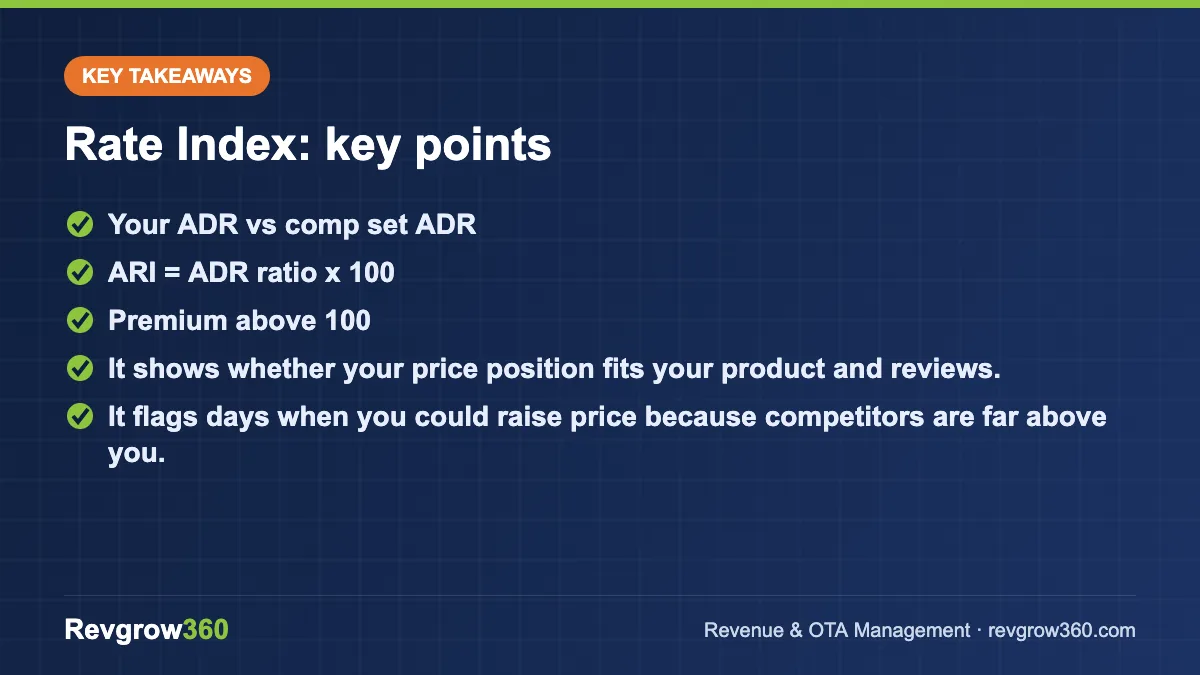
- It shows whether your price position fits your product and reviews.
- It flags days when you could raise price because competitors are far above you.
- It warns you when discounting has dragged your rate below the market.
- It helps you plan a premium strategy and track whether it works over time.
How to improve ARI
Raise rates on high-demand dates
Review dates when the market is full. If your hotel sells out early at a low rate, raise it. See dynamic pricing strategy.
Improve the product and reviews
Guests pay more for good photos, strong reviews, cleanliness and service. Invest in what guests mention most. See hotel online reputation management.
Shift the channel and segment mix
Reduce reliance on deep-discount channels. Grow direct bookings, corporate accounts and packages that raise average rate. See how to increase direct bookings.
Use packages and room types
Sell higher room categories and add-ons such as breakfast, to raise the average rate per room sold.
A simple premium strategy using ARI
Suppose a hypothetical 30-room hotel in Udaipur has an ARI of 92 and good reviews. The owner decides to close the gap in three steps. First, raise rates by a modest amount on the ten highest-demand dates and watch pickup. Second, add a breakfast package at a higher rate than room only. Third, reduce allocation to the lowest-rate channel on weekends. After three months, ARI moves to 97 while MPI falls from 104 to 101. RGI improves, which shows the premium strategy works. The numbers are illustrative, but the approach is practical: move rate gradually and watch the occupancy index.
Common ARI mistakes
- Using the wrong comp set. A luxury hotel compared with budget hotels gives a meaningless result.
- Chasing ARI alone. A high rate with very low occupancy lowers revenue per room.
- Ignoring room type mix. A hotel with more suites will have a higher ADR for structural reasons.
- Mixing taxes. Compare rates on the same tax basis.
- Using different periods. Compare the same dates.
How often to review ARI
Review ARI monthly for strategy and weekly for key dates when you have competitor rate data. Look at weekday and weekend ARI separately, since a hotel may hold a premium at weekends and sell at a discount midweek.
Related terms
MPI, RGI, competitive set, ADR, RevPAR, rate parity (hotel rate parity), fair share and price positioning.
Key takeaways
- ARI = your ADR divided by comp set ADR, multiplied by 100.
- Above 100 means a rate premium, below 100 a discount to the market.
- Always read ARI with MPI and RGI to avoid buying occupancy at any price or pricing yourself out.
- Raise rate on high-demand dates, improve reviews and shift to better channels to lift ARI.
Revgrow360 helps hotels set price positions backed by data. Explore our hotel revenue management service or book a free consultation.
Frequently asked questions
What does ARI mean in hotels?
ARI stands for Average Rate Index, also called the rate index. It divides your hotel's ADR by the competitive set's ADR and multiplies by 100, showing whether you sell at a premium, in line with or at a discount to your market.
What is a good ARI?
An ARI of 100 means your rate matches the market. A figure above 100 shows a premium, and below 100 a discount. Whether it is good depends on occupancy and reviews, so read it with MPI and RGI rather than on its own.
Can ARI be too high?
Yes. If your ARI is well above 100 and your occupancy index is low, you may be pricing out guests and losing revenue per room. The best position balances rate and occupancy, which the RGI shows.
How can a small hotel calculate ARI without STR?
Pick four to six similar nearby hotels and record their public rates for the same dates and room types regularly. Average them to estimate a comp set rate, then compare it with your ADR. It is less accurate than benchmark data but useful for trends.
More Hotel Glossary guides
RGI (Revenue Generation Index) in Hotels: Meaning & Formula
RGI compares your RevPAR with your competitive set. See the formula, a worked example and how to diagnose and improve it.
MPI (Market Penetration Index) in Hotels: Meaning & Formula
MPI compares your hotel's occupancy with its competitive set. See the formula, an example and how to improve your index.
What is ARPAR in Hotels? Meaning, Examples & Formula
ARPAR adjusts RevPAR for the variable cost of selling rooms. See the formula, a worked example and how to use it.
What is NRevPAR in Hotels? Meaning, Examples & Formula
NRevPAR shows room revenue per available room after distribution costs. See the formula, an example and ways to improve it.
What is RevPAG in Hotels? Meaning, Examples & Formula
RevPAG measures hotel revenue per guest rather than per room. See the formula, an example and ways to improve it.
What is TRevPAR in Hotels? Meaning, Examples & Formula
TRevPAR measures all hotel revenue per available room, not just rooms. See the formula, an example and how to improve it.